With National Anti-Japanese Greetings: Mao Zedong and the Chinese Cooperative Movement

On September 25th, 1939, in the Chinese Communist Party’s current capital of Yenan, leader Mao Zedong typed a letter to the Chinese Industrial Cooperative Association detailing his support for the movement and willingness to collaborate to strengthen both the C.I.C. and C.C.P. movements.

Mao Zedong in 1940

Gentlemen:

I am in favor of the establishment of many small industries in China by means
of cooperatives. Your great devotion to such a cause, and the splendid effort
you have made to help our war of resistance, are deeply appreciated.

If it is possible to build this kind of (cooperative) industries in the guerrilla districts of North China, and in the adjacent war regions in the Northwest, the help would be greatly appreciated and warmly welcomed by the Eighth Route Army and my humble self.

I understand that such a plan is in fact already contemplated. It is very
much hoped that it can be realized, for its contribution to our struggle would
be incalculably great.

I would be most grateful if you would convey this thought to your committees
abroad, and to our countrymen overseas. Here I wish especially to thank our
fellow-countrymen in the Philippines, and the (Industrial Co-operatives)
Promotion Committee there, for they have made great efforts to support our
fatherland and the industrial co-operative movement.

In one word, if we struggle hard, and if China and her foreign friends cooperate together, there can be no doubt of our final victory over the Japanese!

With national anti-Japanese greetings,
Mao Zedong.

The C.I.C. movement went on to have a favorable relationship with the Chinese Communist Party, a stark contrast from its antagonistic relationship with many within the Nationalist Party. Although Indusco ultimately fell out of favor with the CCP as well, Mao’s fondness for the idea was evident; it is even thought to have been the inspiration for his Great Leap Forward in 1958.

Understanding Hyperinflation in Wartime China (1938-1945)

Before we can delve into financial information, I thought it important to contextualize the numbers by providing a brief explanation of the inflation China experienced during the war. During the war, Japan attacked China not only on the battlefield, but also in their wallets. By printing counterfeit bills and creating puppet currencies, Japan worked to weaken the purchasing power of the fabi, the Chinese currency at the time. This, in turn, created a period of hyperinflation that created great turmoil for the Chinese people and the ruling Nationalist Government.

I felt that the best way to show the sheer scale of the hyperinflation China faced during this time was to compare it to the inflation in the US over the early 2020s. I’ll be looking at and comparing two seven-year periods, WWII China from 1938-1945, and the United States from 2018-2025. Imagine you walk into a store in New York in 2018 and decide you want a new pair of $100 shoes. You, as any person would, decide to save up for seven years to get them. CPI data tells us that when you walk back into that store seven years later, you would find the shoes now cost roughly $128.16. The inflation shown here was the most important issue during the 2024 election and likely heavily influenced the outcome. Imagine now, if this store were in China during WWII. When you walked back in seven years later, you would’ve found the shoes cost roughly $124,119.61! This is due to the incredible levels of inflation seen at the time. Where inflation in America reached its peak at ~6.5% in 2022, China’s annual inflation rates rose as high as an estimated 277.70% in 1945!

*Monthly production numbers could not be calculated for the June 1939 date. (Numbers taken from China Handbook 1937-1945 and calculations by Douglas R. Reynolds’ dissertation “THE CHINESE INDUSTRIAL COOPERATIVE MOVEMENT AND THE POLITICAL POLARIZATION OF WARTIME CHINA”. 1975

This is a graph displaying the value of goods produced by Indusco factories in a given month. Just from looking at this graph, it didn’t make sense to me. When reading the graph, it seems obvious that the Indusco movement only grew stronger and more productive throughout the early 40s, which contradicts previous data I collected. This data showed a decline both in the number of co-ops and their workers in late 1941 and into 1942, which suggested to me that their productivity must have taken a hit as well. If we instead attempt to adjust these values for inflation, we can begin to see a clearer picture.

Above is a graph showing the same values of production for Indusco as shown previously, but adjusted for inflation by holding the currency’s value constant to its value in July 1937. By doing this, we can observe a more familiar curve showing an increase in production throughout 1940 and up to June of 1941, where production peaked. This was followed by a decline beginning in late 1941 and continuing throughout the rest of the chart.

The C.I.C. Movement Visualized

The Early C.I.C. (Indusco) Movement originally developed in China during the late 1930s. These graphs, made from data collected from regional reports and estimates from annual conferences in Chongqing, help us visualize the scale and scope of the C.I.C. movement over the decade that followed.

The above two graphs depict the rise of Indusco cooperatives following their inception in 1938. We can observe a steady rise in both co-opted factories, as well as members working within them, which peaks at just under 30,000 workers operating nearly 1,900 co-opted factories across China. Following the Summer of 1941, we see a sharp decline in members working for C.I.C. factories and a decline in cooperative factories as well.

The third graph shows the monthly production value for all C.I.C.s from December 1938 to February 1945. This graph attempts to adjust for the unprecedented inflation China faced during WWII, which means all values are pegged to the 1937 value of China’s currency. This graph mirrors the story in the two graphs above, which detail a rise to late 1941, followed by a decline.

This is largely due to increased suspicion by the Nationalist Government that the C.I.C. movement held communist sentiment. This led to threats, arrests, and even some executions of C.I.C. workers and officials, often without evidence or formal charges levied against them. This, of course, led many more officials and workers to consider resigning, while the rest remained under increased police supervision. Adding to that were the incredible amounts of inflation, which diminished the value of loans and donations the C.I.C. received.

This table breaks down our total co-op number from June 1942 by industry and the seven regions within which they operated at the time. We can see that the most productive regions were located largely in the west, with the exception of the Southeast region, which was made up of the Kiangsi, Kwangtung, and Fukien provinces. This chart also allows us to see the specialization of some regions, such as the southeast, which held half of all chemical cooperative factories, or the northwest region, which had roughly two-thirds of all mining facilities.

*Some numbers are estimated due to the instability of the exchange rate during this time.

This Graph shows who and from where Indusco was funded. The largest percentage, over 23 million, from banks and private loans, were loans from Chinese banks, largely the Bank of China, which gave 18 million. The second largest, government appropriations, gave just over 11 million. Making up around 3% are funds from individuals, committees, and groups from places like China, the Philippines, Hawaii, Burma, Java, India, Siam, Singapore, Australia, New Zealand, England, and the US. At around 2% are “Special Funds”, from notable places such as 50 thousand from Madame Chiang Kai-shek and 6 thousand from Soong Ailing, wife of H.H. Kung, as well as 150 thousand from the American Advisory Committee for Civilian Relief in China, headed by Eleanor Roosevelt. Lastly, there is the paid-up share capital from members, which totals just under 400 thousand.

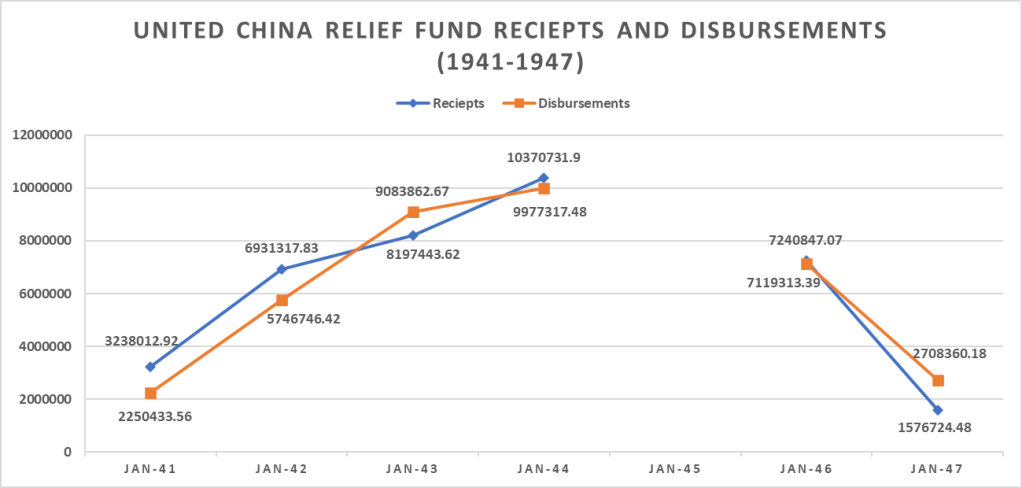
*No data available for 1945.

The United China Relief Fund was a cooperative association that provided aid to China and its people, beginning during the Second World War in 1941 and continuing until 1949. The above graph shows the receipts, or money donated, to the United China Relief Fund and disbursements, or money used by the fund. These disbursements were used for all types of aid to Chinese citizens, such as medical and public health projects, child welfare, education, reconstruction, disaster relief, and rehabilitation.