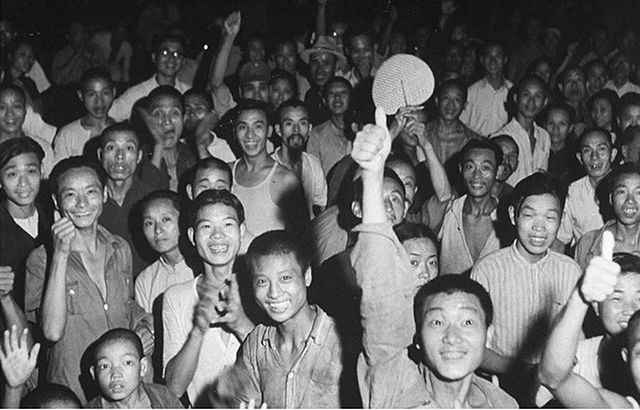
Jack Chen and the Visual Propaganda of Indusco

One of the major accomplishments of Indusco (the American Committee in Aid of Chinese Industrial Cooperatives) was its international propaganda and fundraising campaign. In addition to publishing the monthly Indusco Bulletin in English to inform foreign supporters about cooperative activities, the Hong Kong-based International Committee for Chinese Industrial Cooperatives produced pamphlets, sent speakers abroad to advocate for China’s wartime cause, and organized fundraising events to support relief efforts. Indusco headquarters also published Chinese-language periodicals and pamphlets that featured workers’ and peasants’ testimonies to mobilize domestic support. While much of this propaganda relied on text, visual materials, such as photographs, drawings, and maps, played a crucial role in communicating the movement’s message.
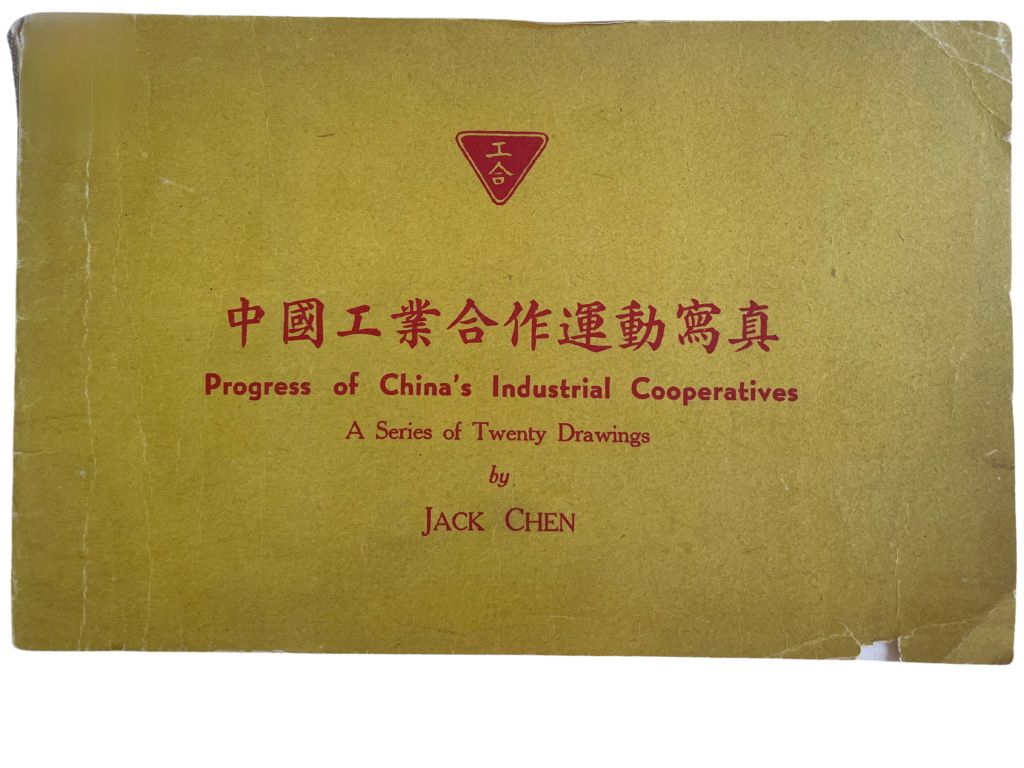
This pamphlet, published by Indusco Inc., featured twenty original drawings by Jack Chen alongside a one-page narrative about the Chinese Industrial Cooperatives. Priced at ten cents, it was sold along with other Indusco publications to help raise funds for the cooperative movement.

Among these visual materials, Jack Chen’s bilingual pamphlet stood out for its compelling depiction of the goals and accomplishments of the cooperative movement. The booklet, which included twenty original drawings illustrating the importance of industrial cooperatives during the war, was used not only for propaganda but also as a key fundraising tool, promoted widely through the Indusco Bulletin.
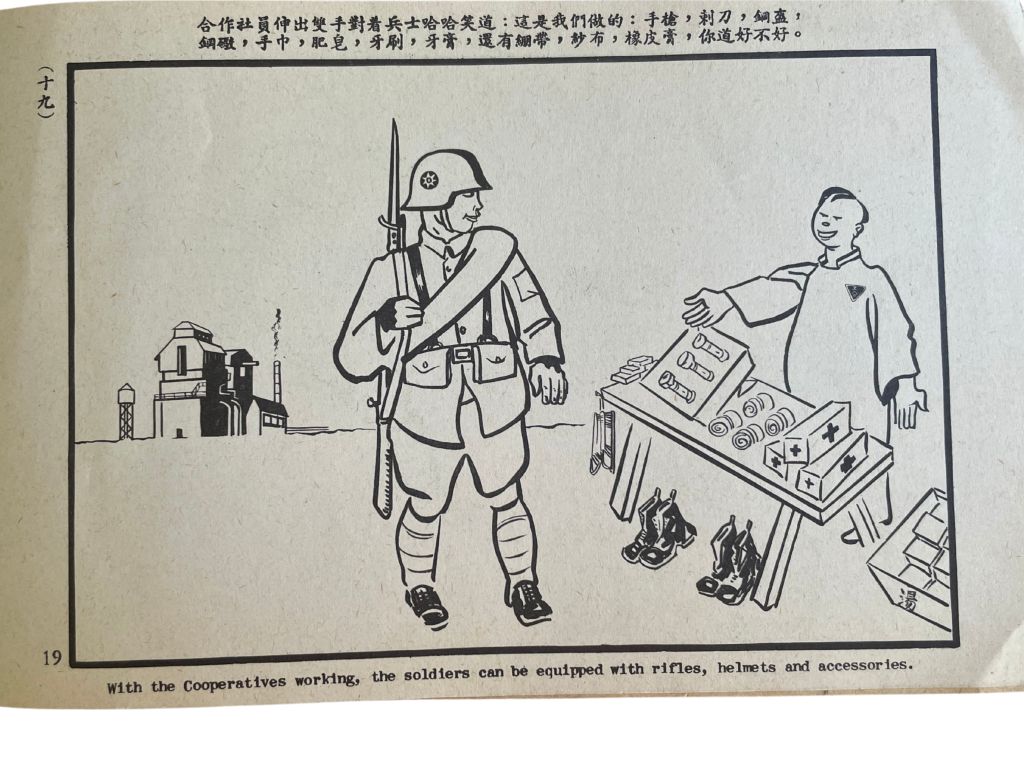
The drawings in the pamphlet highlighted the role of industry in China’s resistance to Japanese occupation.

Jack Chen (1908–1995) was one of the leading cartoonists in wartime China. Trained in art in Soviet Russia, he became a major advocate of socialist realism in Chinese art during the 1930s. Born in Trinidad to a biracial family, Chen used his status as a British citizen in China to bypass local censorship. He published widely in both Chinese and international media, organized exhibitions to foster exchange between Chinese and foreign artists, and supported China’s resistance through his artwork.

A communist sympathizer, Chen visited the Communist base in Yan’an in 1938 and wrote about the experience in the January 1939 issue of Asia magazine. He is perhaps best known for his later books, A Year in Upper Felicity: Life in a Chinese Village During the Cultural Revolution, The Sinkiang (Xinjiang) Story, and The Chinese of America. His personal papers are held at the Hoover Institution Library and Archives in California. For a detailed study of his impact on the Chinese art world, see Paul Bevan’s A Modern Miscellany: Shanghai Cartoon Artists, Shao Xunmei’s Circle, and the Travels of Jack Chen, 1926–1938.
Shaping American views of Asia: A magazine’s decades-long journey

Asia magazine was originally published as the Journal of the American Asiatic Association to promote commercial relations between China, Japan, and the United States.

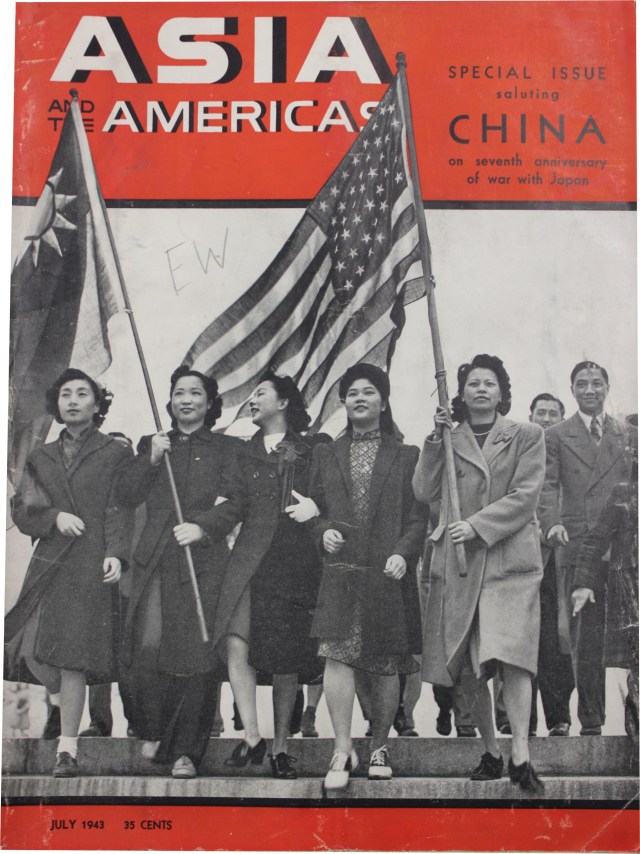
The cover of Asia magazine from 1943

The American Asiatic Association was founded in June 1898 by a group of New York-based American businessmen who had previously lived in Asia. Their goal was to shape public sentiment to support American interests in the Far East.

The first issue of the Journal was published on July 25, 1898. It featured information on Chinese customs revenues and trade regulations along the Yangtze River. The final issue under the original title appeared on January 2, 1917.

From its inception, the Association was focused on protecting American business interests in the Philippines and opposed any peace treaty with Spain that did not guarantee an “open door” policy, which would ensure equal trade opportunities for all nations on the islands. Other early topics included Chinese railway projects, Korean trade, the strategic and economic importance of China, and reports from association events.

In 1917, with the 17th volume, the Association relaunched the publication as Asia magazine. Now a monthly, it featured more opinion essays and illustrations. Although its core mission—to promote American influence in Asia—remained unchanged, the editors acknowledged the need to reshape American perceptions of Asia. This shift is reflected in their statement: “The ignorance of our people in regard to the countries of the Far East is unquestionably a serious obstacle to the legitimate extension of American influence” (Asia, March 1917, p. 3). To that end, they began emphasizing social and cultural topics alongside economic and political concerns. That same year, the Association began admitting women as members.

In November 1917, in compliance with the Post Office Appropriation Act of August 24, 1917, the magazine disclosed its ownership: Asia Publishing Company, with A. W. Feidler and G. H. Rennick as trustees, and Willard Straight as the principal bondholder. By the 1920s, the magazine listed Willard Straight as its founder in the front matter.

After Straight died in 1918, his widow, Dorothy Straight, married Leonard K. Elmhirst in 1925. Together, they continued to publish the Asia magazine. During this period, the journal adopted the subtitle “The American Magazine on the Orient.”

In 1933, Pearl S. Buck’s husband and publisher, Richard Walsh, became the journal’s editor. In 1941, Buck purchased the magazine from the Elmhirsts and rebranded it as Asia and the Americas in 1942. Under her leadership, the magazine increasingly focused on political analysis and war reporting. Prominent contributors included William Ernest Hocking, Hu Shih, Owen Lattimore, Lin Yutang, Jawaharlal Nehru, Edgar Snow, and Nym Wales (Helen Foster Snow). Buck regularly wrote for the book review section.

In 1947, Asia and the Americas merged with Free World (October 1941–December 1946) and Inter-American (May 1942–November 1946) to form United Nations World.