“Our Seven–Their Five”: Everyday Life and Cooperation in Wartime China

Our Seven–Their Five: A Fragment from the Story of Gung Ho is a fictional work by Rewi Alley, the technical director of the Chinese Industrial Cooperatives during the Second Sino-Japanese War. Alley wrote this story in 1943, while living in a village in the Qinling Mountains of Shaanxi Province. He had recently returned from Hunan, where he observed famine conditions and the devastating effects of the Japanese advance. Drawing on these experiences, he produced a vivid portrait of ordinary life in wartime China. However, the book was not published until 1963, well after the Communist victory, at a time when Chiang Kai-shek was portrayed as a central antagonist of the people’s struggle. Reflecting that political context, Alley depicts the Nationalist regime as obstructing the cooperative movement, a view consistent with 1960s ideological narratives.

Our Seven–Their Five is not centered on one protagonist. Instead, the story follows a group of refugees from Hunan Province who flee famine and war to settle in a small town. There, they meet Fu, a cooperative organizer educated in Beijing, who helps them form a cooperative enterprise. According to the cooperative rules, at least seven people were needed to register a group, but the refugees were only five. They therefore joined forces with seven weavers to reach the required number—hence the title, “Our Seven–Their Five.” With support from the Cooperative Federation, providing loans and organizational guidance, they managed to launch a small but successful operation. Through teamwork and persistence, the refugees began to rebuild their lives.

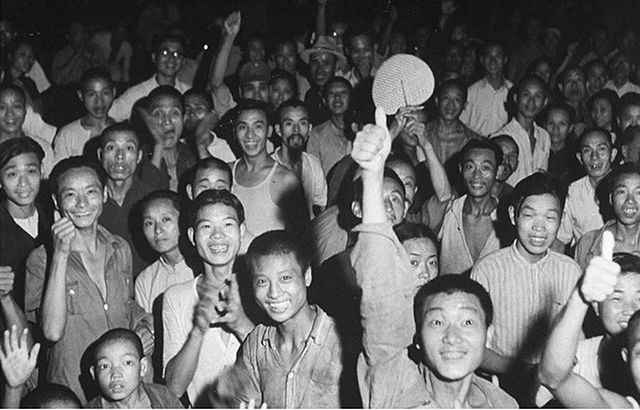
Indusco Weaving Cooperative

The story stands out because it offers a rare ground-level view of wartime China. Rather than focusing on generals, political leaders, or major battles, Alley documents the daily realities of refugees, laborers, and peasants whose survival depended on cooperation. In his depiction, life and death coexist with unsettling normalcy: people die, yet work continues; tragedy is woven into the fabric of everyday endurance.

There is even humor. In one memorable scene, a foreign inspector visits a cooperative (clearly Alley himself), and local children gossip about how strange the foreigner looks, especially his long nose, which they imagine could dip right into his teacup. Moments like this humanize the story and reflect Alley’s lighthearted way of addressing cultural encounters.

Equally important is his refusal to reduce Chinese society to a simple Communist vs. Nationalist binary. Instead, Alley portrays a complex human landscape shaped by hardship, survival, and moral ambiguity. He writes with empathy for the refugees and displaced people, emphasizing their struggles to adapt to rural life amid famine, disease, and Japanese occupation.

The story also captures the class tensions and corruption that persisted even within the cooperative system. In one episode, we see a local landlord sponsoring a cooperative not out of solidarity but to gain easy access to credit and manipulate grain prices during a period of hyperinflation. Such moments reveal how some cooperatives, especially in Nationalist-controlled areas, were exploited as quasi-private enterprises rather than genuine collectives.

By highlighting these abuses, Alley underscores that the cooperative movement was not uniformly idealistic or successful. Some cooperatives functioned as large factories; others resembled small capitalist ventures; and still others truly fulfilled their mission of mutual aid and community resilience. Amid this uneven landscape, Alley still finds hope in the cooperative spirit and endurance of ordinary Chinese people. 
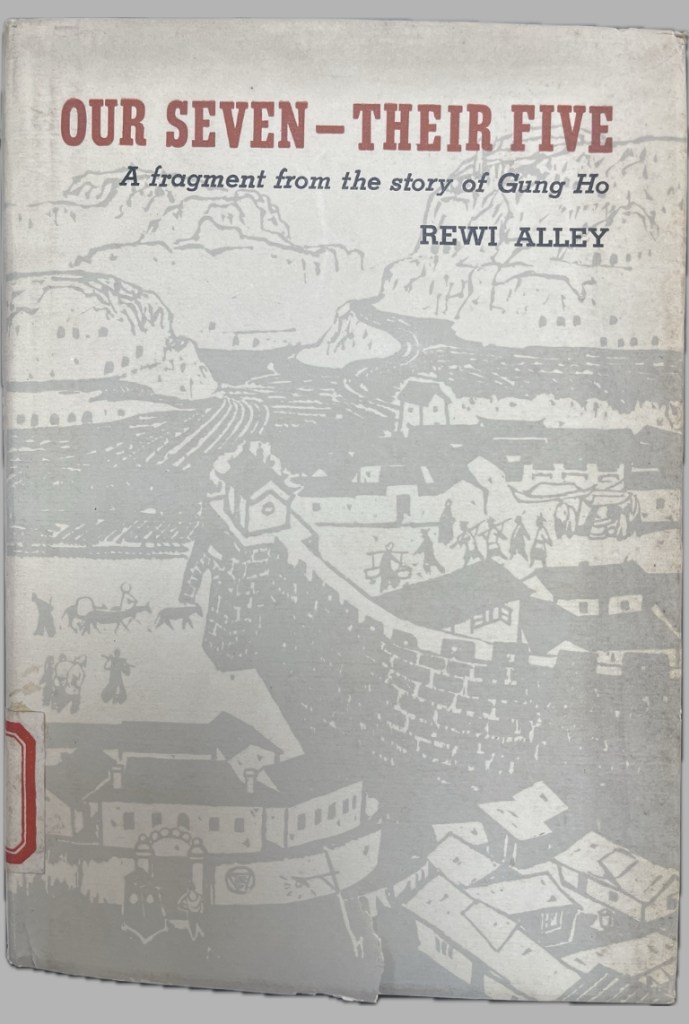
Our Seven–Their Five was published by New World Press, Beijing in 1963

With National Anti-Japanese Greetings: Mao Zedong and the Chinese Cooperative Movement

On September 25th, 1939, in the Chinese Communist Party’s current capital of Yenan, leader Mao Zedong typed a letter to the Chinese Industrial Cooperative Association detailing his support for the movement and willingness to collaborate to strengthen both the C.I.C. and C.C.P. movements.

Mao Zedong in 1940

Gentlemen:

I am in favor of the establishment of many small industries in China by means
of cooperatives. Your great devotion to such a cause, and the splendid effort
you have made to help our war of resistance, are deeply appreciated.

If it is possible to build this kind of (cooperative) industries in the guerrilla districts of North China, and in the adjacent war regions in the Northwest, the help would be greatly appreciated and warmly welcomed by the Eighth Route Army and my humble self.

I understand that such a plan is in fact already contemplated. It is very
much hoped that it can be realized, for its contribution to our struggle would
be incalculably great.

I would be most grateful if you would convey this thought to your committees
abroad, and to our countrymen overseas. Here I wish especially to thank our
fellow-countrymen in the Philippines, and the (Industrial Co-operatives)
Promotion Committee there, for they have made great efforts to support our
fatherland and the industrial co-operative movement.

In one word, if we struggle hard, and if China and her foreign friends cooperate together, there can be no doubt of our final victory over the Japanese!

With national anti-Japanese greetings,
Mao Zedong.

The C.I.C. movement went on to have a favorable relationship with the Chinese Communist Party, a stark contrast from its antagonistic relationship with many within the Nationalist Party. Although Indusco ultimately fell out of favor with the CCP as well, Mao’s fondness for the idea was evident; it is even thought to have been the inspiration for his Great Leap Forward in 1958.

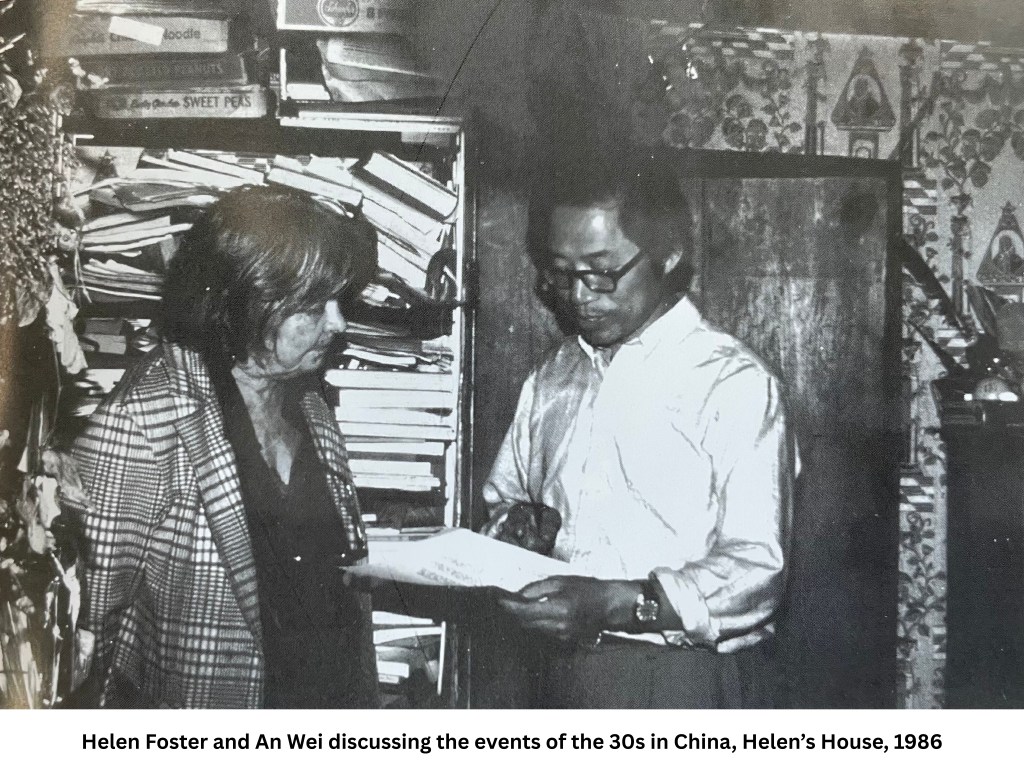
Interpreter, Translator, Friend: An Wei and the Legacy of Helen Foster Snow

An Wei, a scholar and translator, first met Helen Foster Snow during her visit to China in 1978, when he was assigned as her interpreter. Their encounter quickly developed into a lifelong friendship. Moved by her work and story, An Wei took on the task of translating Helen Foster’s writings into Chinese and, during a 1985 stay in Hartford, Connecticut, gained access to her personal archive.

An Wei graduated with a degree in English in 1966. Amid the political turmoil of the Great Proletarian Cultural Revolution, he was appointed an English interpreter at the Foreign Affairs Office of the Shaanxi Provincial Government. At the time, China received very few foreign visitors, and much of An Wei’s work involved studying Mao Zedong’s writings in English. In 1970, he was allowed to observe American journalist Edgar Snow’s visit to Yan’an from a distance because only senior cadres could attend these high-level missions. Despite the lack of direct interaction, An Wei was inspired to read more of Snow’s work. In 1971, after being reassigned to the Yan’an History Museum, he encountered additional English-language materials about China, including Edgar Snow’s Red Star Over China and Helen Foster Snow’s Inside Red China.

By 1978, when Helen Foster Snow was preparing to return to China for a short trip, An Wei had resumed his position in the Provincial Foreign Affairs Office. Although he was not the first interpreter selected by officials, Helen Foster specifically requested his assistance due to his fluency in English and knowledge of revolutionary history. This request allowed them to travel together and marked the beginning of a deeper intellectual and personal connection.

Their correspondence continued after the trip, with Helen frequently asking An Wei to help publish her writings in China. In 1982, during a Chinese delegation’s visit to Minnesota, the group briefly met Helen Foster in her Madison home. An Wei’s access to her personal papers came during his residency as a Visiting Scholar at Trinity College in Hartford, Connecticut, from September 1985 to September 1986. During that year, he visited her almost weekly and worked closely with her manuscripts. It was during this period that he also rediscovered the letters he had written to her, which he later published in Chinese.

An Wei served as a translator during numerous high-level diplomatic missions, including visits by U.S. President Jimmy Carter, Vice President Walter Mondale, and Secretary of State Henry Kissinger. He has translated and published 18 books and more than 100 articles in both Chinese and international publications.

(Based on An Wei’s own account of his relationship with Helen Foster Snow in An Wei Wenji, 2013.)

Jack Chen and the Visual Propaganda of Indusco

One of the major accomplishments of Indusco (the American Committee in Aid of Chinese Industrial Cooperatives) was its international propaganda and fundraising campaign. In addition to publishing the monthly Indusco Bulletin in English to inform foreign supporters about cooperative activities, the Hong Kong-based International Committee for Chinese Industrial Cooperatives produced pamphlets, sent speakers abroad to advocate for China’s wartime cause, and organized fundraising events to support relief efforts. Indusco headquarters also published Chinese-language periodicals and pamphlets that featured workers’ and peasants’ testimonies to mobilize domestic support. While much of this propaganda relied on text, visual materials, such as photographs, drawings, and maps, played a crucial role in communicating the movement’s message.

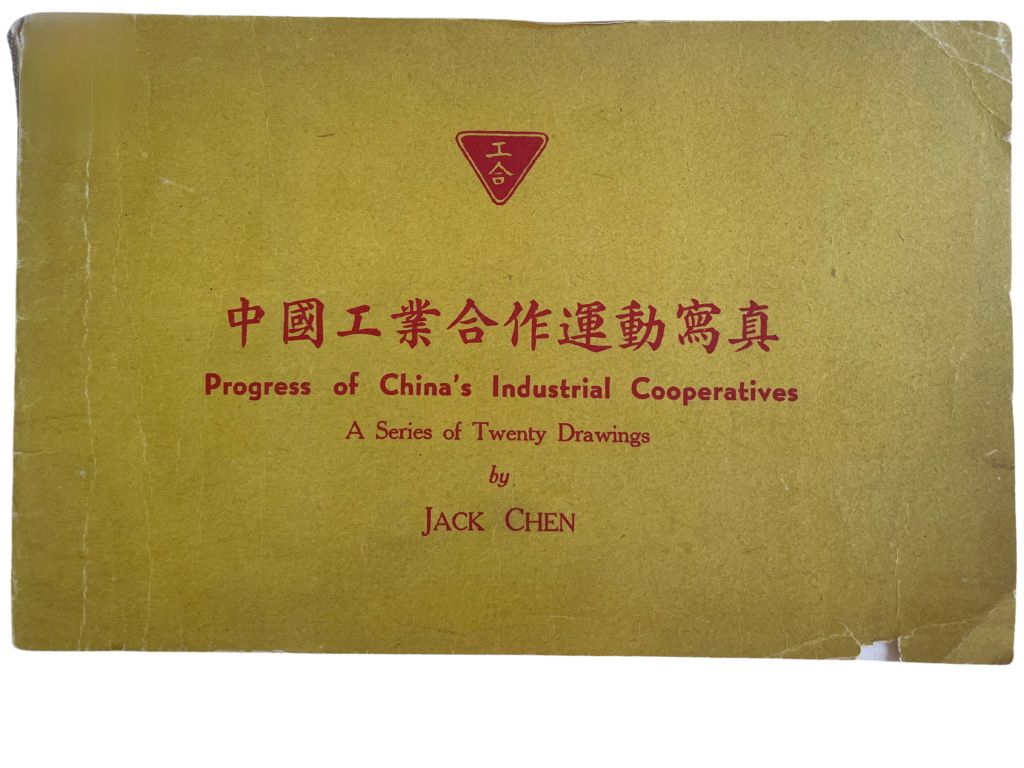
This pamphlet, published by Indusco Inc., featured twenty original drawings by Jack Chen alongside a one-page narrative about the Chinese Industrial Cooperatives. Priced at ten cents, it was sold along with other Indusco publications to help raise funds for the cooperative movement.

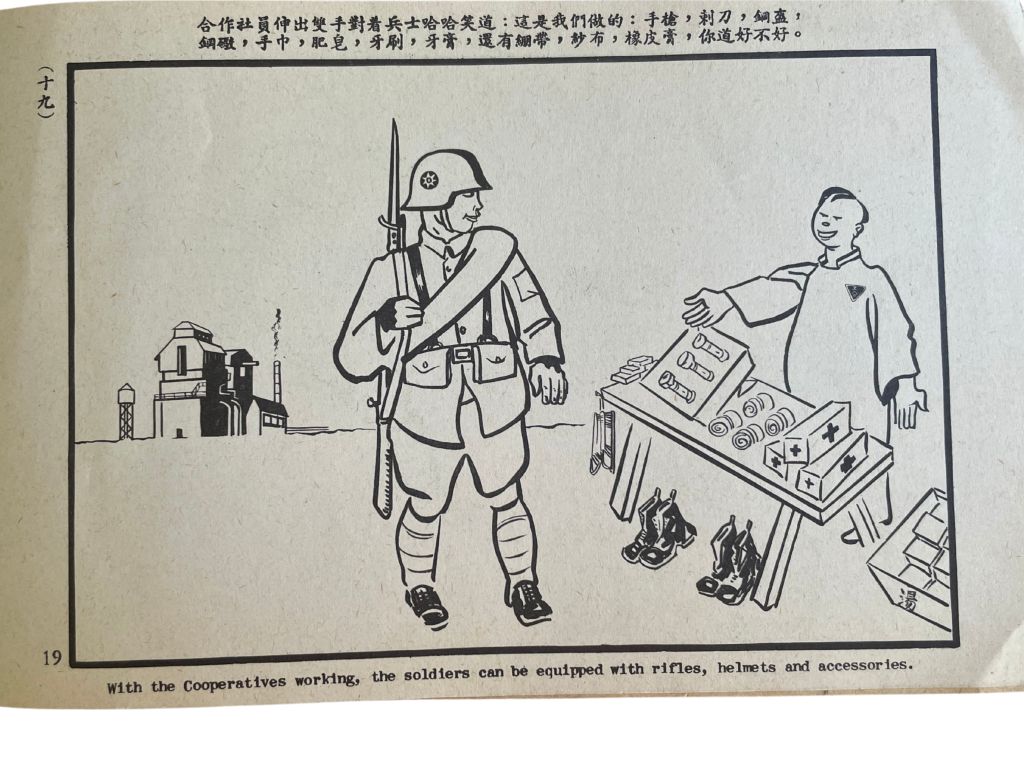
Among these visual materials, Jack Chen’s bilingual pamphlet stood out for its compelling depiction of the goals and accomplishments of the cooperative movement. The booklet, which included twenty original drawings illustrating the importance of industrial cooperatives during the war, was used not only for propaganda but also as a key fundraising tool, promoted widely through the Indusco Bulletin.

The drawings in the pamphlet highlighted the role of industry in China’s resistance to Japanese occupation.

Jack Chen (1908–1995) was one of the leading cartoonists in wartime China. Trained in art in Soviet Russia, he became a major advocate of socialist realism in Chinese art during the 1930s. Born in Trinidad to a biracial family, Chen used his status as a British citizen in China to bypass local censorship. He published widely in both Chinese and international media, organized exhibitions to foster exchange between Chinese and foreign artists, and supported China’s resistance through his artwork.

A communist sympathizer, Chen visited the Communist base in Yan’an in 1938 and wrote about the experience in the January 1939 issue of Asia magazine. He is perhaps best known for his later books, A Year in Upper Felicity: Life in a Chinese Village During the Cultural Revolution, The Sinkiang (Xinjiang) Story, and The Chinese of America. His personal papers are held at the Hoover Institution Library and Archives in California. For a detailed study of his impact on the Chinese art world, see Paul Bevan’s A Modern Miscellany: Shanghai Cartoon Artists, Shao Xunmei’s Circle, and the Travels of Jack Chen, 1926–1938.

The C.I.C. Movement Visualized

The Early C.I.C. (Indusco) Movement originally developed in China during the late 1930s. These graphs, made from data collected from regional reports and estimates from annual conferences in Chongqing, help us visualize the scale and scope of the C.I.C. movement over the decade that followed.

The above two graphs depict the rise of Indusco cooperatives following their inception in 1938. We can observe a steady rise in both co-opted factories, as well as members working within them, which peaks at just under 30,000 workers operating nearly 1,900 co-opted factories across China. Following the Summer of 1941, we see a sharp decline in members working for C.I.C. factories and a decline in cooperative factories as well.

The third graph shows the monthly production value for all C.I.C.s from December 1938 to February 1945. This graph attempts to adjust for the unprecedented inflation China faced during WWII, which means all values are pegged to the 1937 value of China’s currency. This graph mirrors the story in the two graphs above, which detail a rise to late 1941, followed by a decline.

This is largely due to increased suspicion by the Nationalist Government that the C.I.C. movement held communist sentiment. This led to threats, arrests, and even some executions of C.I.C. workers and officials, often without evidence or formal charges levied against them. This, of course, led many more officials and workers to consider resigning, while the rest remained under increased police supervision. Adding to that were the incredible amounts of inflation, which diminished the value of loans and donations the C.I.C. received.

This table breaks down our total co-op number from June 1942 by industry and the seven regions within which they operated at the time. We can see that the most productive regions were located largely in the west, with the exception of the Southeast region, which was made up of the Kiangsi, Kwangtung, and Fukien provinces. This chart also allows us to see the specialization of some regions, such as the southeast, which held half of all chemical cooperative factories, or the northwest region, which had roughly two-thirds of all mining facilities.

*Some numbers are estimated due to the instability of the exchange rate during this time.

This Graph shows who and from where Indusco was funded. The largest percentage, over 23 million, from banks and private loans, were loans from Chinese banks, largely the Bank of China, which gave 18 million. The second largest, government appropriations, gave just over 11 million. Making up around 3% are funds from individuals, committees, and groups from places like China, the Philippines, Hawaii, Burma, Java, India, Siam, Singapore, Australia, New Zealand, England, and the US. At around 2% are “Special Funds”, from notable places such as 50 thousand from Madame Chiang Kai-shek and 6 thousand from Soong Ailing, wife of H.H. Kung, as well as 150 thousand from the American Advisory Committee for Civilian Relief in China, headed by Eleanor Roosevelt. Lastly, there is the paid-up share capital from members, which totals just under 400 thousand.

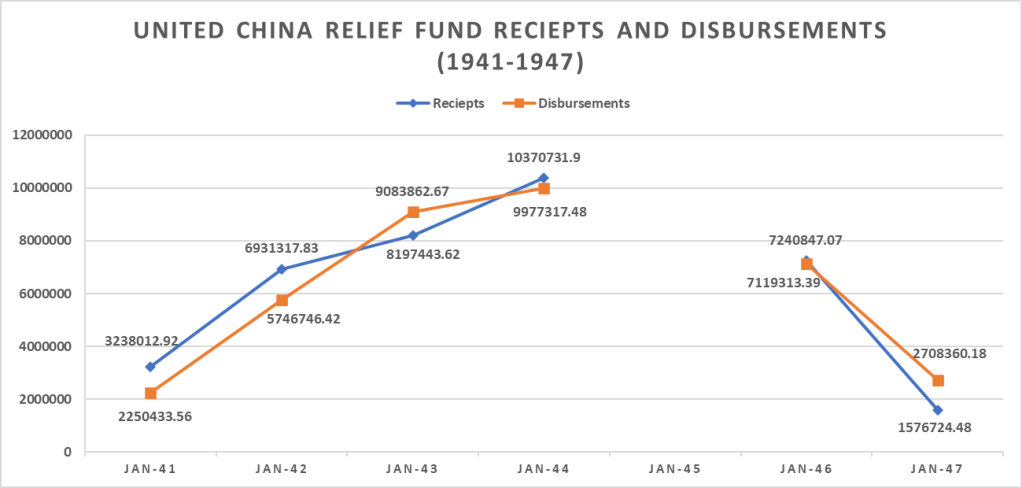
*No data available for 1945.

The United China Relief Fund was a cooperative association that provided aid to China and its people, beginning during the Second World War in 1941 and continuing until 1949. The above graph shows the receipts, or money donated, to the United China Relief Fund and disbursements, or money used by the fund. These disbursements were used for all types of aid to Chinese citizens, such as medical and public health projects, child welfare, education, reconstruction, disaster relief, and rehabilitation.