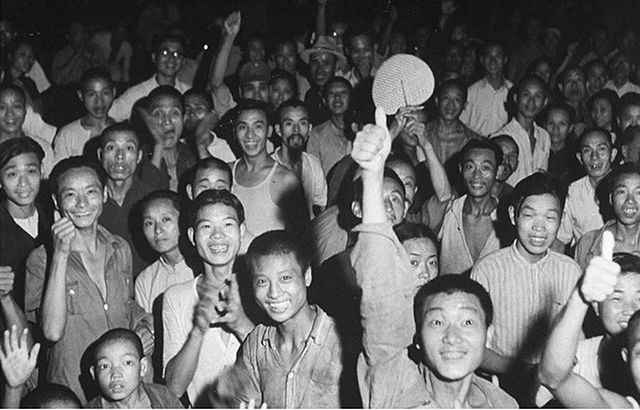
Chinese Industrial Cooperatives (CIC), commonly known as “Indusco” or “Gung Ho,” was a citizen initiative that emerged in wartime China and lasted until the early years of the People’s Republic (1938–1952). It brought the contending Nationalist and Communist parties together around the idea of preserving China’s industrial production and supporting its resistance by employing refugees from the occupied regions in mobile production units to be built in safer areas away from Japanese bombing.
The idea for mobile production units originated with Helen Foster Snow, who was inspired by British diplomat John Alexander when he introduced the concept of cooperatives at an evening gathering in Shanghai. Although initially skeptical, Foster quickly embraced the idea after discovering that agricultural cooperatives were already common in various parts of China. It was her husband, journalist Edgar Snow, along with their friend Rewi Alley, a former factory inspector for the Shanghai Municipal Council, who used their connections to recruit the first group of participants, many of whom were local Chinese.
The cooperatives had four stated goals: to eliminate Japanese goods from the Chinese market; to meet the specific needs of the army and guerrilla forces; to provide employment for refugee populations through productive enterprises; and to lay the foundation for industrial production in postwar China (Robert W. Barnett, “Chinese Industrial Cooperatives on Trial,” The Far Eastern Survey, 9:5, February 28, 1940).
The project gained momentum when Soong Ching-ling (Madame Sun Yat-sen) and her brother, banker T. V. Soong, offered their full support. Madame Chiang Kai-shek (Soong Meiling) assumed leadership of the initiative, overcoming resistance from Finance Minister H. H. Kung, who feared that a cooperative movement might empower the Communist Party. Thanks to Madame Chiang’s determination, the Association of Chinese Industrial Cooperatives (ACIC) was officially established in Wuhan on August 5, 1938.
Indusco Maps
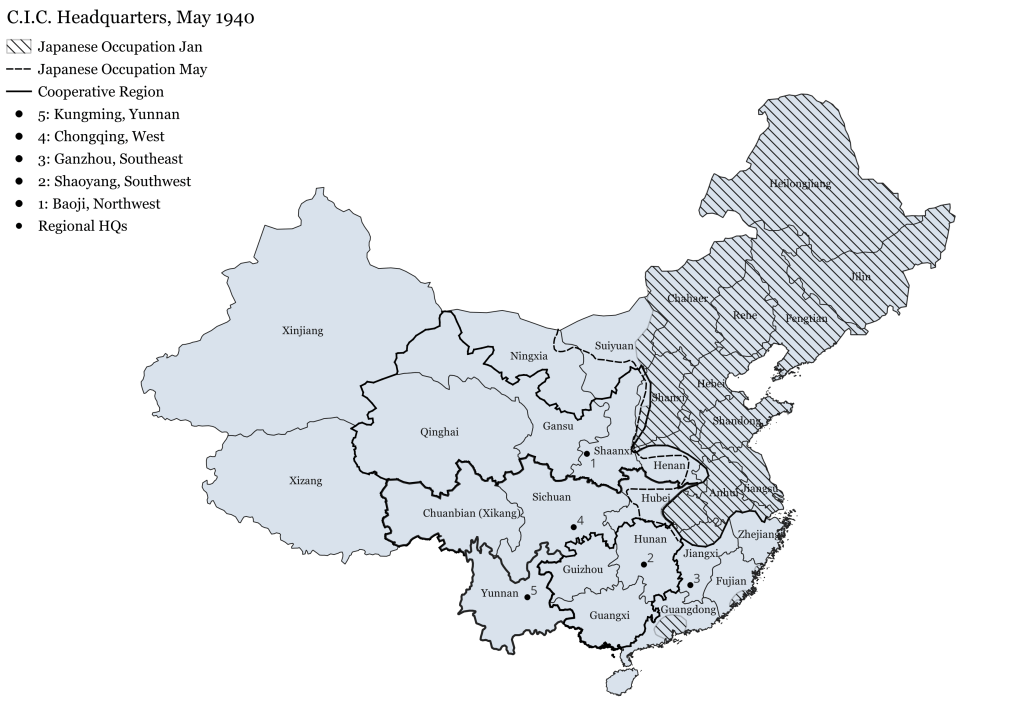
The map above illustrates China’s five industrial cooperative regions and their headquarters amidst Japanese occupation by 1940. Organization around regional headquarters enabled C.I.C’s to form a network of cooperative units centered around key depot sites. Through the allocation of raw materials, labor, and manufacturing equipment here, unoccupied China was able to create an industrialized economy and supply the war effort.
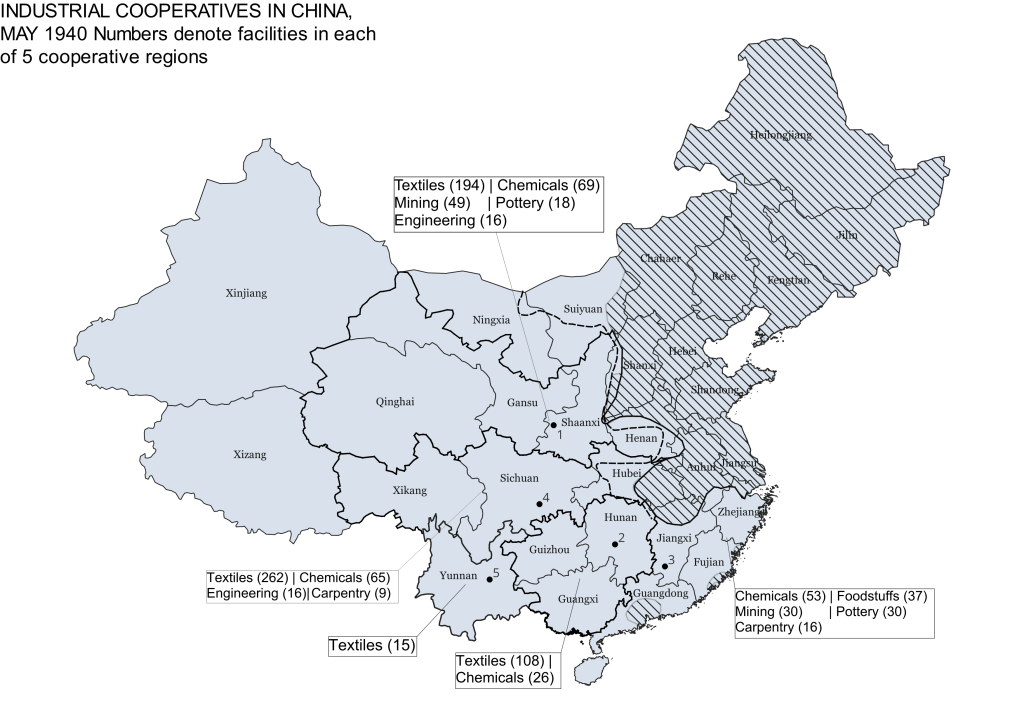
This map details the number of Indusco facilities in each region by May 1940, categorized by industry. Note only the largest industries of each region are listed.
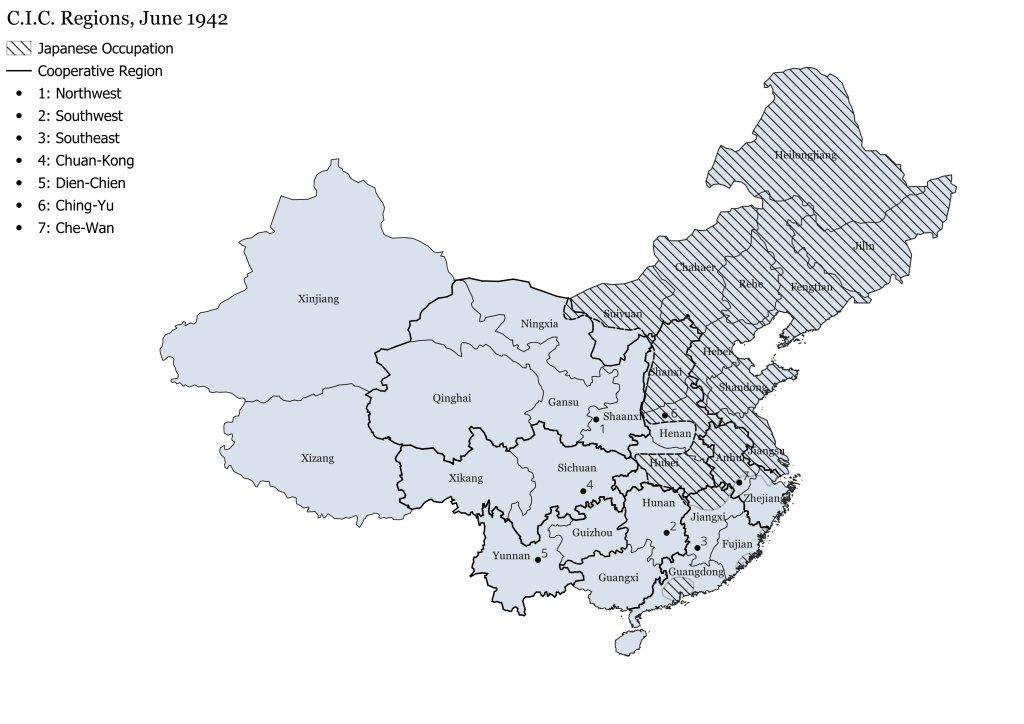
By the summer of 1942, Indusco had expanded from five to seven main regions of operation. The updated map above illustrates the new administrative boundaries for these sprouting industrial cooperatives.

 China in WW2