The Early C.I.C. (Indusco) Movement originally developed in China during the late 1930s. These graphs, made from data collected from regional reports and estimates from annual conferences in Chongqing, help us visualize the scale and scope of the C.I.C. movement over the decade that followed.
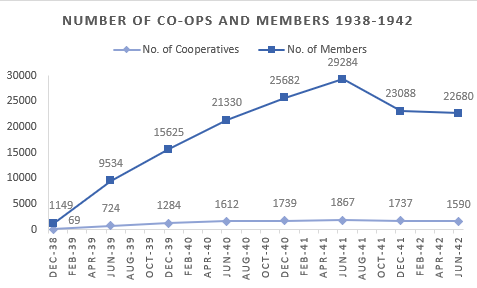
This Graph depicts the rise of Indusco cooperatives following their inception in 1938. We can observe a steady rise in both co-opted factories, as well as members working within them, which peaks at just under 30 thousand workers operating nearly 19 hundred coopted factories across China. This rise was halted in late 1941 and into 1942, when large losses due to inflation and the consolidation of many cooperatives into larger units drove totals down.

This table breaks down our total co-op number from June 1942 by industry and the seven regions within which they operated at the time. We can see that the most productive regions were located largely in the west, with the exception of the Southeast region, which was made up of the Kiangsi, Kwangtung, and Fukien provinces.

*Data in Chinese Yuan
This graph shows the rapid development of C.I.C. cooperatives during 1939 and into 1940. Over just a year and a half, C.I.C. co-opts grew to producing over 6 million worth of goods monthly, with those numbers likely being conservative and estimated to equal 9 million by July of 1940.

*Data is in Chinese Currency, some numbers are estimated due to the instability of the exchange rate during this time
This Graph shows who and from where Indusco was funded. The largest percentage, over 23 million, from banks and private loans, were loans from Chinese banks, largely the Bank of China, which gave 18 million. The second largest, government appropriations, gave just over 11 million. Making up around 3% are funds from individuals, committees, and groups from places like China, the Philippines, Hawaii, Burma, Java, India, Siam, Singapore, Australia, New Zealand, England, and the US. At around 2% are “Special Funds”, from notable places such as 50 thousand from Madame Chiang Kai-shek and 6 thousand from Soong Ailing, wife of H.H. Kung, as well as 150 thousand from the American Advisory Committee for Civilian Relief in China, headed by Eleanor Roosevelt. Lastly, there is the paid-up share capital from members, which totals just under 400 thousand.
 China in WW2